In November 1999 Janet Kinrade Dethick, a retired Senior Lecturer in Human Studies living in Italy who researches and writes about the Second World War in north-west Umbria and south-eastern Tuscany, paid her first visit to the cemetery and was instrumental in organising the first Remembrance Day ceremony in 2000.
Who were these young soldiers who lie in this cemetery?
In the cemetery record book we can find out the names of their parents and wives, where they came from and the date on which they died. Only two graves belong to unknown soldiers.
Where and in what action did they fall?
Contrary to what may be deduced from the following comment on cwgc.org
Orvieto War Cemetery was established as a battlefield cemetery by the 78th Division in the middle of June 1944
no battle took place in the vicinity of Orvieto. All the fallen came form the approach to, or the battles on, the Trasimene Line.
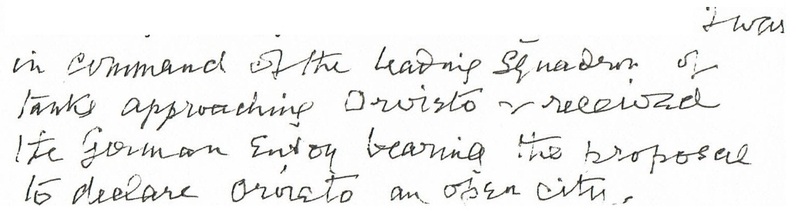
Here is an excerpt from a letter received by Janet Kinrade Dethick from Major R. Hesletine of 3 Hussars:
Who were these young soldiers who lie in this cemetery?
In the cemetery record book we can find out the names of their parents and wives, where they came from and the date on which they died. Only two graves belong to unknown soldiers.
Where and in what action did they fall?
Contrary to what may be deduced from the following comment on cwgc.org
Orvieto War Cemetery was established as a battlefield cemetery by the 78th Division in the middle of June 1944
no battle took place in the vicinity of Orvieto. All the fallen came form the approach to, or the battles on, the Trasimene Line.
Here is an excerpt from a letter received by Janet Kinrade Dethick from Major R. Hesletine of 3 Hussars:
The answer to the above question can be found through research into the story of the Second World War in Italy. Whilst General Mark Clark, Commander-in-Chief of the American Fifth Army was holding his press conference on the steps of the Campidoglio in Rome, the troops under the command of the British Eighth Army were pursuing the retreating Germans to the north of the city. 78 British Infantry 'Battleaxe' Division was given the task of following the Rome - Florence railway line to Orvieto and thence to Lake Trasimeno. Available sources indicate that the major actions in which 78 Division were involved were as follows:
at Montegabbiano on 16 June
at Città della Pieve on 17 June
at Villastrada on 19-20 June
at Sanfatucchio and Pucciarelli 21-22 June
at Pescia and Ranciano on 24 June
during the advance to Castiglione del Lago 25-29 June
during the advance to the River Spina 29 June -2 July
So, by putting together the date of a soldier's death and looking at his unit's actions it is often possible to come up with the answer.
What research along these lines has been done so far?
The Commonwealth War Graves Commission's cemetery register has been re-arranged into alphabetical order. (See The Fallen)
The major histories of 78 Division and the war diary for each of its regiments have been consulted. It is therefore possible to specify the area in which each man was killed and sometimes even the exact action. Generally speaking, if his rank was that of sergeant or above the circumstances of his death arre documented, though there is a great deal of variation in the detail from one War Diary to another. For the private soldier, if his company is known it is sometimes possibile to arrrive at the action in which he lost his life.
Local people have been interviewed, who on occasion were able to supply detailed information about the circumstances of an individual's death.
Here is just one example of what has been pieced together about an individual soldier:
Lance Sergeant William Frederick Bovaird aged 27 of Belfast no. 6878669 Royal Irish Fusiliers
Local research has established that in Sant'Arcangelo on the southern shore of Lake Trasimeno a group of young boys witnessed the last skirmish between the defending Germans and a platoon of Allied soldiers. One of the soldiers was killed and another was wounded.
1 Royal Irish Fusiliers War Diary records that they were the first unit to reach the southern shore of Lake Trasimeno on 19 June 1944. Here is part of the entry for that date:
1530 hrs. patrol sent to village at 508891 where enemy are reported to be. A short clash took place in which Sgt. Bovaird was killed and L/Cpl Brown wounded. A prisoner was captured from 4 Parachute Regt.
By consulting a map in use at the time it has been possible to confirm that the village referred to was Sant'Arcangelo. The person who witnessed the scene indicated where the action had taken place and it was photographed.
at Montegabbiano on 16 June
at Città della Pieve on 17 June
at Villastrada on 19-20 June
at Sanfatucchio and Pucciarelli 21-22 June
at Pescia and Ranciano on 24 June
during the advance to Castiglione del Lago 25-29 June
during the advance to the River Spina 29 June -2 July
So, by putting together the date of a soldier's death and looking at his unit's actions it is often possible to come up with the answer.
What research along these lines has been done so far?
The Commonwealth War Graves Commission's cemetery register has been re-arranged into alphabetical order. (See The Fallen)
The major histories of 78 Division and the war diary for each of its regiments have been consulted. It is therefore possible to specify the area in which each man was killed and sometimes even the exact action. Generally speaking, if his rank was that of sergeant or above the circumstances of his death arre documented, though there is a great deal of variation in the detail from one War Diary to another. For the private soldier, if his company is known it is sometimes possibile to arrrive at the action in which he lost his life.
Local people have been interviewed, who on occasion were able to supply detailed information about the circumstances of an individual's death.
Here is just one example of what has been pieced together about an individual soldier:
Lance Sergeant William Frederick Bovaird aged 27 of Belfast no. 6878669 Royal Irish Fusiliers
Local research has established that in Sant'Arcangelo on the southern shore of Lake Trasimeno a group of young boys witnessed the last skirmish between the defending Germans and a platoon of Allied soldiers. One of the soldiers was killed and another was wounded.
1 Royal Irish Fusiliers War Diary records that they were the first unit to reach the southern shore of Lake Trasimeno on 19 June 1944. Here is part of the entry for that date:
1530 hrs. patrol sent to village at 508891 where enemy are reported to be. A short clash took place in which Sgt. Bovaird was killed and L/Cpl Brown wounded. A prisoner was captured from 4 Parachute Regt.
By consulting a map in use at the time it has been possible to confirm that the village referred to was Sant'Arcangelo. The person who witnessed the scene indicated where the action had taken place and it was photographed.